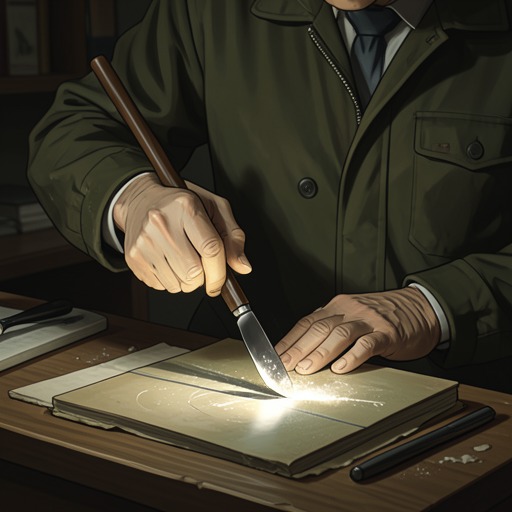
The difference between Zhan and Kan
The Book of Five RingsThe distinction between cutting and slashing defines the difference between decisive action and mere contact in the sword’s use. A wound may be forceful, or even fatal, yet still count as a slash if the action’s spirit is only to touch; a cut, by contrast, is made with resolved intent. The distinction links a precise judgment about a stroke to the book’s broader account of strategy as a practical Way for overcoming opponents, from individual combat to large-scale battle.
The Distinction in the Stroke
The teaching begins by refusing to define a cut simply by what happens to the enemy’s body. Slashing is touching, even when the blow is strong and the enemy dies at once. Cutting requires a resolute spirit: the decisive feature is the intention with which the stroke is made, not the visible violence of its effect. The contrast therefore separates outcome from action. Death alone cannot retroactively make a slash into a cut.
The difference does not mean that a slash has no place in combat. If a swordsman first slashes at an enemy’s hands or legs, the instruction is to follow with a strong cut. The first contact may open or affect the encounter, but it is not the decisive action in itself. The teaching directs attention beyond the initial touch to what must follow: a resolute stroke that completes the attack.
The passage also complicates its own division. Once the practitioner understands that slashing is, in spirit, touching, cutting and slashing can become indistinguishable. This does not erase the initial contrast; it makes the distinction a matter of comprehension and action rather than a fixed classification of outward motions. The student is told to learn the difference deeply enough to see through it.
Strategy Beyond a Single Stroke
The distinction belongs to a Way presented as more than a collection of sword techniques. The warrior’s practice is described as a means of overcoming men, whether through crossing swords with individuals or engaging larger forces; victory may bring power and fame to the warrior or the warrior’s lord. In that context, the cut-versus-slash distinction gives close attention to the purpose behind an action: a contact that looks effective is not necessarily the decisive act strategy demands.
The book organizes its teaching into five books—Ground, Water, Fire, Wind, and Void—each associated with a different aspect of the Way. The cut-and-slash instruction appears as a named lesson within this systematic account of sword practice. Its compact contrast exemplifies the book’s insistence that students examine not only visible technique but also the principle that gives technique its force.
Training the Body and Judgment
The distinction is framed by an account of training that brings bodily form and intention together. The prescribed stance is composed and aligned: the head is erect, the shoulders are lowered, strength runs through the legs, and the abdomen is braced. The companion sword is wedged in the belt against the abdomen. Everyday posture is to become combat posture, so that readiness is not an isolated pose adopted only at the instant of fighting.
The gaze is likewise trained as an instrument of judgment. The practitioner is to see distant things as though close and close things from a distance, recognize the enemy’s sword without distraction by its lesser movements, and maintain a broad gaze applicable to both single combat and large-scale strategy. Against this background, deciding whether a stroke is merely touching or truly decisive is part of a larger discipline of perceiving what matters amid movement.
That discipline extends to the hands and feet. The long sword is held with a pliable grip: the last two fingers are tight, while the thumb and forefinger have a more floating feeling. A fixed hand is described as dead, while pliability is living; the grip must remain intent on cutting without becoming rigid. Footwork, too, should resemble normal walking whether the steps are fast or slow, large or small. The teaching of cutting thus sits within a practice that resists both lifeless fixedness and empty motion.
From Duel to Army
The distinction’s strategic reach is made explicit by the book’s movement between individual combat and warfare. Small techniques are judged inadequate when full armour is worn, while the Way is presented as a sure method for fighting for one’s life against five or ten opponents. The author extends the principle from one fighter overcoming ten to a thousand overcoming ten thousand, while acknowledging that such numbers cannot be assembled for everyday training. Individual practice with a sword is instead meant to build understanding of an enemy’s strategy, strength, and resources, and of how strategy can be applied against a much larger force.
Knowing the times carries the same movement from the individual encounter to command. In battle, the strategist assesses whether the enemy’s disposition is flourishing or waning, observes the spirit of the enemy’s men, seeks the best position, and moves troops accordingly. In a duel, the practitioner recognizes the opponent’s school, quality, strengths, and weaknesses, then attacks at an unsuspected moment by judging the opponent’s rhythm and timing. The decisive cut is therefore not an isolated ideal of force: it belongs to a Way that joins trained action to reading an opponent and selecting the moment to act.
A Practical, Open-Ended Way
The book presents itself as an outline to be studied and tested, not as a catalogue that fixes every school’s doctrine. In the Wind Book, the author surveys other traditions so that readers can understand the essence of his own school. He declines to name those traditions or prescribe their central points, explaining that branches interpret doctrines differently and that no single person’s conception can stand for every school. The account of cutting and slashing has the same practical emphasis: it states a distinction, gives an example of how a slash may precede a cut, and asks the student to investigate the principle rather than rely on labels.
Its final significance lies in the tension between firmness and flexibility. The cut requires resolved intent, but the distinction between cutting and slashing may dissolve once its meaning is fully understood; the sword hand must be intent without becoming fixed, and strategy must be decisive without shrinking into a single technique. The lesson makes the stroke a test of understanding: not how forcefully the sword touches, but whether the action serves the Way of defeating the enemy.